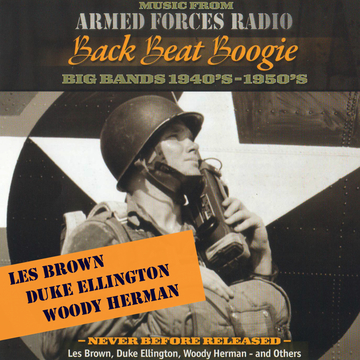
Les Brown, Sr. (March 14, 1912 – January 24, 2001) and the Band of Renown are a big band that began in the big band era of the late 1930s and now performs under the direction of his son Les Brown, Jr.
‘Les Brown and the Band of Renown’ brought Doris Day into prominence with their recording of Sentimental Journey in 1945. The release of Sentimental Journey coincided with the end of WWII in Europe and was the homecoming theme for many veterans. They had nine other number-one hit songs, including I’ve Got My Love to Keep Me Warm.
Les Brown and the Band of Renown performed with Bob Hope on radio, stage and TV for almost fifty years. They did 18 USO Tours for American troops around the world, and entertained over three million. Before the Super Bowls were televised, the Bob Hope Christmas Specials were the highest-rated programs in television history. Tony Bennett was “discovered” by Bob Hope and did his first public performance with Les and the Band.
Ellington, Duke (Edward Kennedy Ellington), 1899–1974, American jazz musician and composer, b. Washington, D.C. Ellington made his first professional appearance as a jazz pianist in 1916. By 1918 he had formed a band, and after appearances in nightclubs in Harlem he became one of the most famous figures in American jazz. Ellington’s orchestra, playing his own and Billy Strayhorn’s compositions and arrangements, achieved a fine unity of style and made many innovations in the jazz idiom.
Many instrumental virtuosos worked closely with Ellington for long periods of time. Among his best-known short works are Mood Indigo,Solitude, and Sophisticated Lady. He also wrote jazz works of complex orchestration and ambitious scope for concert presentation, notably Creole Rhapsody (1932), Black, Brown and Beige (1943), Liberian Suite (1947), Harlem (1951), and Night Creatures (1955), and composed religious music, including three sacred concerts (1965, 1968, and 1973). Ellington made many tours of Europe, appeared in numerous jazz festivals and several films, and made hundreds of recordings. In 1969 he received the Presidential Medal of Freedom.
Woodrow Charles Herman (May 16, 1913 – October 29, 1987), better known as Woody Herman, was an American jazz clarinetist, alto and soprano saxophonist, singer, and Big band leader. During his lifetime, he led some of the most exciting big bands of the twentieth century. His bands changed styles and approaches to jazz but still managed to keep their musical integrity.
Herman was born in Milwaukee, Wisconsin. As a child he worked as a singer in vaudeville, then became a professional saxophone player at age 15. When Isham Jones’s band, of which Herman had been a member, broke up in 1936, he formed his own band, the Woody Herman Orchestra, with some of his band mates. This band became known for its orchestrations of the blues and was sometimes billed as “The Band That Plays The Blues”.
On April 12, 1939 Woody Herman recorded his greatest commercial and mega popular hit record “Woodchoppers’ Ball”, featuring Woody on clarinet, Neal Ried on trombone, Saxie Mansfield on Sax, Steady Nelson on trumpet and Hy White on guitar. Other big early hits were “Blue Flame,” “Dupree Blues”, “Blues Upstairs and Downstairs” and “Blues in the Night” with Joe Bishop on flugelhorn, Tommy Linehans on piano, Cappy Lewis on trumpet, and the strong rhythm team of Walt Yoder and Frankie Carlson.